Our Research Areas and Techniques

At the P. Banerjee Energy Lab (PBEnergyLab), based in Chicago, we integrate synthetic inorganic chemistry, advanced electron microscopy, machine learning, and electrochemistry to accelerate discovery of next-generation solid electrolytes and nanoscale superionic conductors. Our work bridges atomic-level defect engineering with scalable solution processing, enabling transformative advances in solid-state batteries and energy conversion.

PBEnergyLab Vision: We aim to establish design rules for nanoscale superionic conductors, advancing both fundamental solid-state ionics and applied energy technologies. Our ultimate goal is to provide scalable, manufacturable pathways for safe, high-energy-density batteries and clean hydrogen systems. By combining theory with automation and AI, we’re not merely optimizing- we’re discovering entirely new families of nanoscale ionic materials

We actively seek collaborations with research scientists and independent PIs from academia, industry , and DOE national laboratories with complementary technical interests.

Synthetic mapping of metastable phases

Material classes include (metal) selenides, nitrides, sulfides, halides using hot injection quantum-dot seeded method

[Manuscript DOI: 10.1002/sstr.202500238 Small Structures, 2500238, 2025]
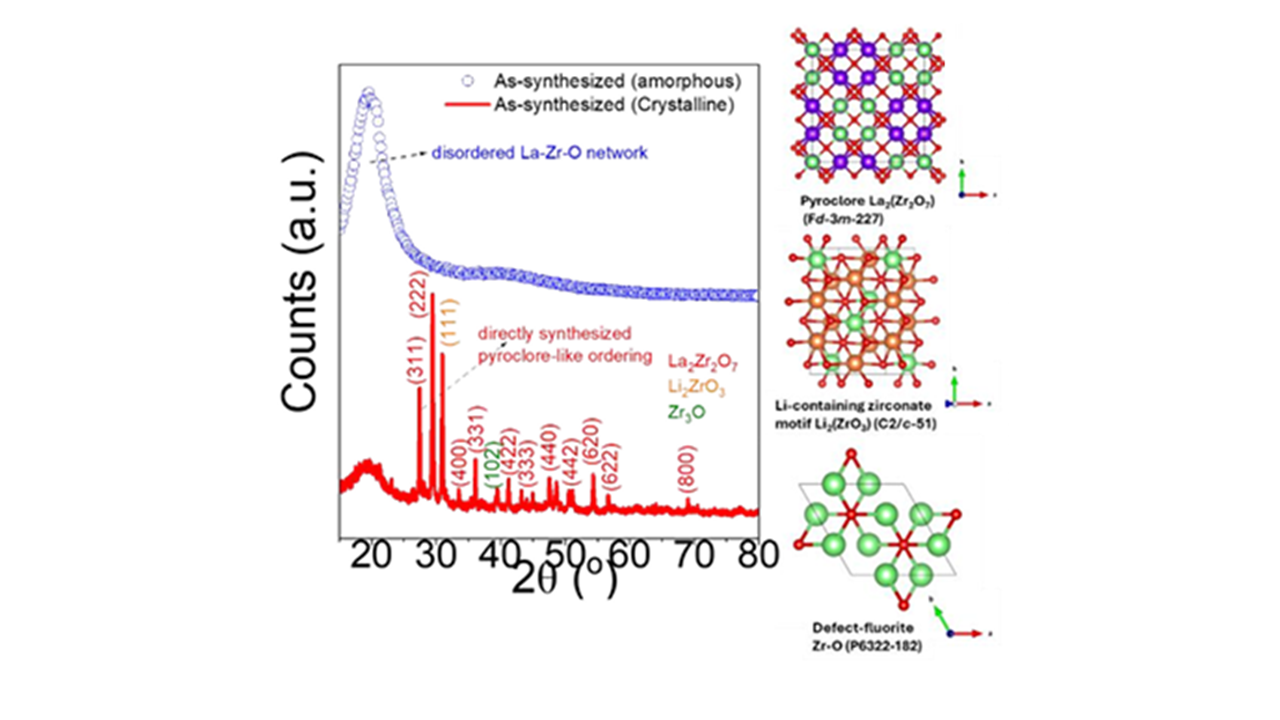
x-ray based structural investigations (diffraction-XRD, absorption-XANES/EXAFS, scattering-GISAXS)

Synchrotron and tabletop facilities are being used to evaluate structure-property correlations in solid electrolyte candidates [Preprint DOI: 10.26434/chemrxiv.10001476/v1 License:  CC BY NC ND 4.0 (authors retain copyright). No publisher formatting.]

Advanced Analytical and Aberration-Corrected Transmission Electron Microscopy (HR-TEM, EDS, EELS, 4DSTEM and tomography) to study defect pathways, atomic design and strain with reconstructed superionic pathways in solid electrolytes

Scale bar is 10 nm
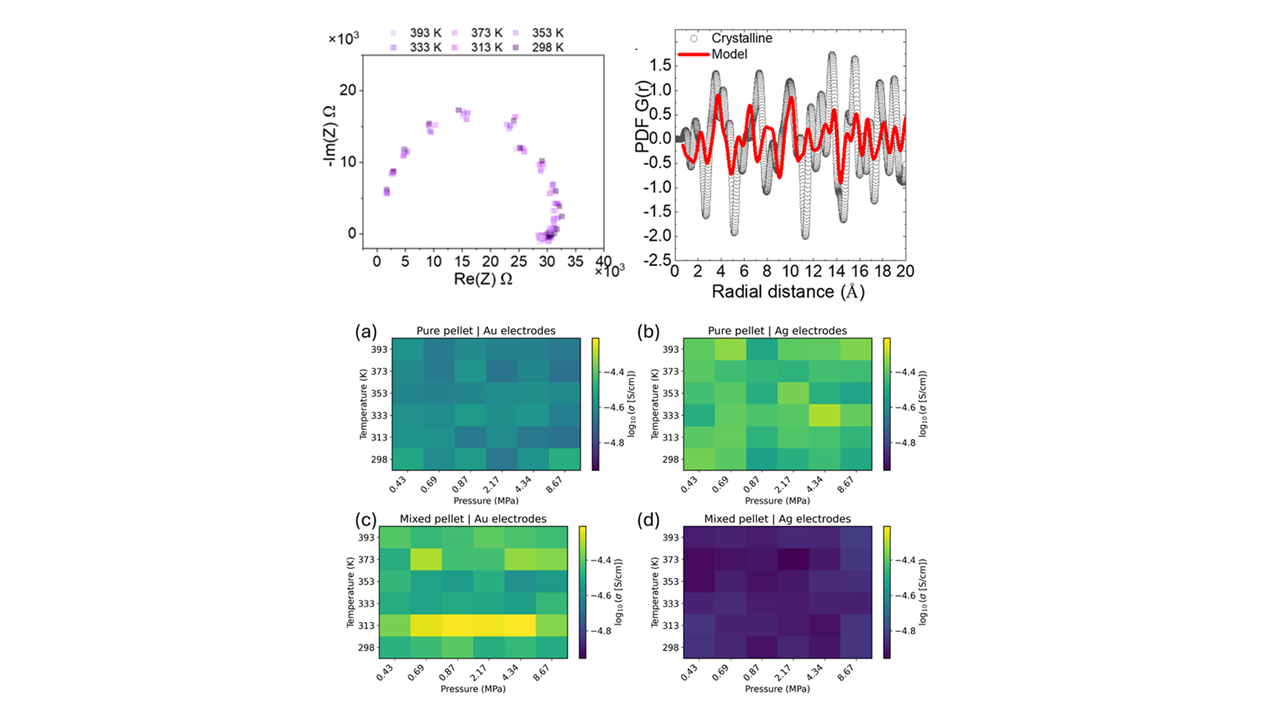
Lowering of activation barriers of Li+ and Na+ migration in solid electrolytes: studied using in-lab electrochemical setup (EIS, CV, GITT) with DSC, solid-state NMR, EXAFS, pair-distribution etc.

[Preprints DOI: 10.26434/chemrxiv.10001476/v1 and 10.26434/chemrxiv-2026-t7qrx License:  CC BY NC ND 4.0 (authors retain copyright). No publisher formatting.]

Performance studies of potential Li+ battery solid-electrolyte candidates under extreme conditions

[Manuscript DOI: 10.1021/acs.nanolett.4c01285 Nano Letters, 24, 23, 6981, 2024]

Meet the PI

Dr. Progna Banerjee

Selected as a 2026 Rising Star in Materials Science by ACS Materials Au: Invited contribution to the Rising Stars collection (in preparation)

PBEnergyLab Timeline

JAN 2026

Named to ACS Materials Au’s 2026 Rising Stars in Materials Science

Recognized as a Global Rising Star: an international, editor-curated feature for early-career investigators for fundamental contributions in disseminating bottlenecks in percolation and ionic transport across ligand-capped nanocrystals for energy storage.

Submitted three foundational manuscripts (J24, J25, J27) advancing the frontiers of materials synthesis (lattice-encoded templates), electrochemistry (pressure-resolved nanoionics), and grain boundary engineering (phase transformation bottlenecks in solid electrolytes).

2024 – 2025

Establishment of PBEnergyLab: Independent PI Career

Lead PI Publication: Disseminated mechanisms of ambient chemical lithiation in quantum-dot seeded systems (Small Structures, 19.4).
High-Impact Review: Nano Energy (30.4) on charge transport and ligand-mediated coupling in energy storage applications.
DOE Feature: Selected for the Department of Energy Art of Science Mural at the Forrestal Building (Washington, D.C.).
Grants: Awarded 2025 Research Support Grant for the discovery of CuBSe₂ superionic phases.

Group Milestones: Mentored student recipients of Mulcahy, Provost, and AIC National fellowships.

2021 – 2024

Argonne National Laboratory: Core Postdoc

1 of 8 national appointees at the Center for Nanoscale Materials (CNM). Discovered novel high-pressure CsCl-type structures in copper selenides via GSECARS beamline at the Advanced Photon Source (Nano Letters 2024). Established that oxygen facilitates redox-mediated transformation while precursor valency dictates the preservation of metastable 2D morphologies (Chemistry of Materials 2023) 2022 ACS-CAS Future Leader (1 of 30 worldwide).

2019 – 2021

Berkeley & UT Austin: Interdisciplinary Fellowships

EBI–Shell ALS Fellow (Berkeley Lab): Bridged PLD-based thin-film battery design with interface chemistry.
NSF MRSEC Postdoc (UT Austin): DoD MURI research on Fano resonance and light-matter interaction in bioinspired materials (Adv. Photon. Res. 2023).

2014 – 2018

Ph.D. UIUC: Bridging Physics and Chemistry

Conducted doctoral research in chemically engineered phase transitions in quantum-dot seeded materials at the Departments of Chemistry, Materials Research Lab and Physics while training in colloidal synthetic chemistry. Discovered the “liquid-like” melting of cationic sublattices in nanoclusters—translating superionic physics into wet-chemical design (Nature Communications 2017). Featured in Smithsonian Magazine, UIUC News Bureau, AzoNano, CEMag, Physorg, EurekaAlert, R&D Magazine for synthetically controlled breakthrough solid-electrolyte nanoclusters. Accomplished five university degrees across two continents.

FOUNDATIONS

IIT Kharagpur & National Top 1%

National GATE Top 1%: (Graduate Physics).
JAM National Top 1%: Excellence in STEM entrance exams.
Gold Medalist: Hiron Bala Memorial Gold Medal for academic distinction among all STEM disciplines in the College.

Footnotes & Resource Links:

  • Research Thrusts: Defect engineering, Interface chemistry, & Robotics [Direct Link]
  • Publications: High-throughput discovery and superionic conducting materials [Direct Link]
  • Lab History: Details on fellowships (NSF, EBI-Shell, MURI) and media highlights [Direct Link]

Thrust 1: Nanoscale Ionics & Defect Engineering

We design and synthesize colloidal nanocrystals and nanoclusters of complex chalcogenides with tunable composition, morphology, and vacancy density. By leveraging phase-mapping workflows, our lab uncovers how grain size, symmetry breaking, and defect structures govern superionic phase transitions. We move beyond traditional synthesis to establish fundamental rules for ionic conductivity in next-generation solid-state materials

Thrust 2: Engineering Interfaces for Macro-scale Ion Transport

We utilize surface and interface chemistry strategies to tailor interparticle coupling and build solution-processable superionic films and inks. This thrust bridges the gap between nanoscale defect engineering and macroscopic electrolyte performance, enabling the translation of fundamental discovery into high-performance interfaces for all-solid-state batteries, fuel cells, and hybrid catalytic systems.

Thrust 3: Data-Driven Discovery & Autonomous Pipelines

We integrate atomic-resolution TEM/4D-STEM and automated Rietveld refinement with physics-informed machine learning (ML) workflows to identify structure–property correlations across large synthetic libraries. By building autonomous discovery pipelines, we accelerate the identification of optimal compositions, shortening the material discovery cycle from years to months and establishing a new paradigm for high-throughput materials chemistry.