
At the P. Banerjee Energy Lab (PBEnergyLab), based in Chicago, our group develops colloidal and nanocrystal-derived materials to uncover how non-equilibrium synthesis, nanoscale disorder, and interfacial architecture control ion transport in solid-state energy systems. Our research integrates synthetic inorganic chemistry, advanced structural characterization, electrochemistry, and data-guided workflows to build design rules for solid electrolytes, ion-conducting interfaces, and scalable energy-materials platforms.
Why This Work Matters
Future energy technologies will depend on materials that move ions rapidly, remain stable under realistic operating conditions, and can be manufactured from scalable chemistries. Yet many promising solid electrolytes and interfacial materials fail because their transport pathways are poorly understood across length scales — from atomic disorder and defect chemistry to particle contacts, grain boundaries, and macroscopic device interfaces.
PBEnergyLab addresses this gap by using colloidal synthesis to access metastable and nanostructured materials, then connecting their structure, disorder, processing history, and electrochemical response. Our approach is designed for a materials landscape where discovery increasingly depends on integrated synthesis, advanced characterization, user-facility measurements, and data-guided interpretation — not isolated trial-and-error experiments.

Meet the PI: Prof. Progna Banerjee, Ph.D.
Research Themes
PBEnergyLab develops independent, corresponding-author research programs around metastable ion-conducting nanomaterials, nanoionic interfaces, polymer–nanocrystal electrolytes, and data-guided materials discovery.
1. Metastable Phase Discovery #Metastable_nanocrystal_synthesis, #Chalcogenide_nanocrystals, #Phase_mapping, #Data-Guided_Discovery, #Advanced_Characterization
PBEnergyLab uses colloidal and non-equilibrium synthesis to access nanocrystal phases that are difficult to isolate by conventional solid-state routes. We map how reaction pathway, composition, and thermal evolution control phase selection, structural disorder, and ion-transport potential.
Figure 1: Colloidal synthesis maps reveal how kinetic reaction pathways select metastable nanocrystal phases.
Selected Works:
- Under Review: Mapping Kinetic Phase Selection in a Colloidal Library of Metastable Silver Multinary Chalcogenide Nanocrystals
- Published: Colloidal La–Zr–O Nanophases Reveal an Amorphous-to-Pyrochlore Transformation that Precludes LLZO Formation
- Published: Colloidal Hot‐Injection Synthesis of CuBSe2 Nanocrystals: Tetragonal Chalcogenide Templates for Superionic Lithiation Pathways
2. Nanoionics, Contacts, and Interphases #Nanoionics, #Chalcogenide_nanocrystals, #SolidElectrolytes, #Interphases, #Pressure-resolved_EIS
Ion transport in nanocrystal-derived solids is shaped by more than crystal structure. Particle contacts, grain boundaries, ligands, pressure, electrode interfaces, and interphase evolution can dominate the measured electrochemical response. We develop pressure- and temperature-resolved measurements to distinguish intrinsic transport from contact-limited and interfacial behavior.
Figure 2: Pressure-resolved impedance separates bulk transport from contact and interfacial resistance in nanocrystal-derived solids.
Selected Works:
- Under Review: Pressure-Resolved Impedance Reveals Contact-Limited Nanoionics in Nanocrystal-Derived Solid Electrolytes
- Under Review: Copper Vacancies Govern Lithium Interphase Evolution in Nanocrystal-Derived Cu–B–Se Electrolytes
- Invited: Writing Ion-Transport Networks through Colloidal Pathways for Solid Electrolytes
3. Strain, Defects, and Microscopic Transport Pathways #Strain_Defects, #Superionic_transport, #Advanced_Characterization, #Lithiation_chemistry
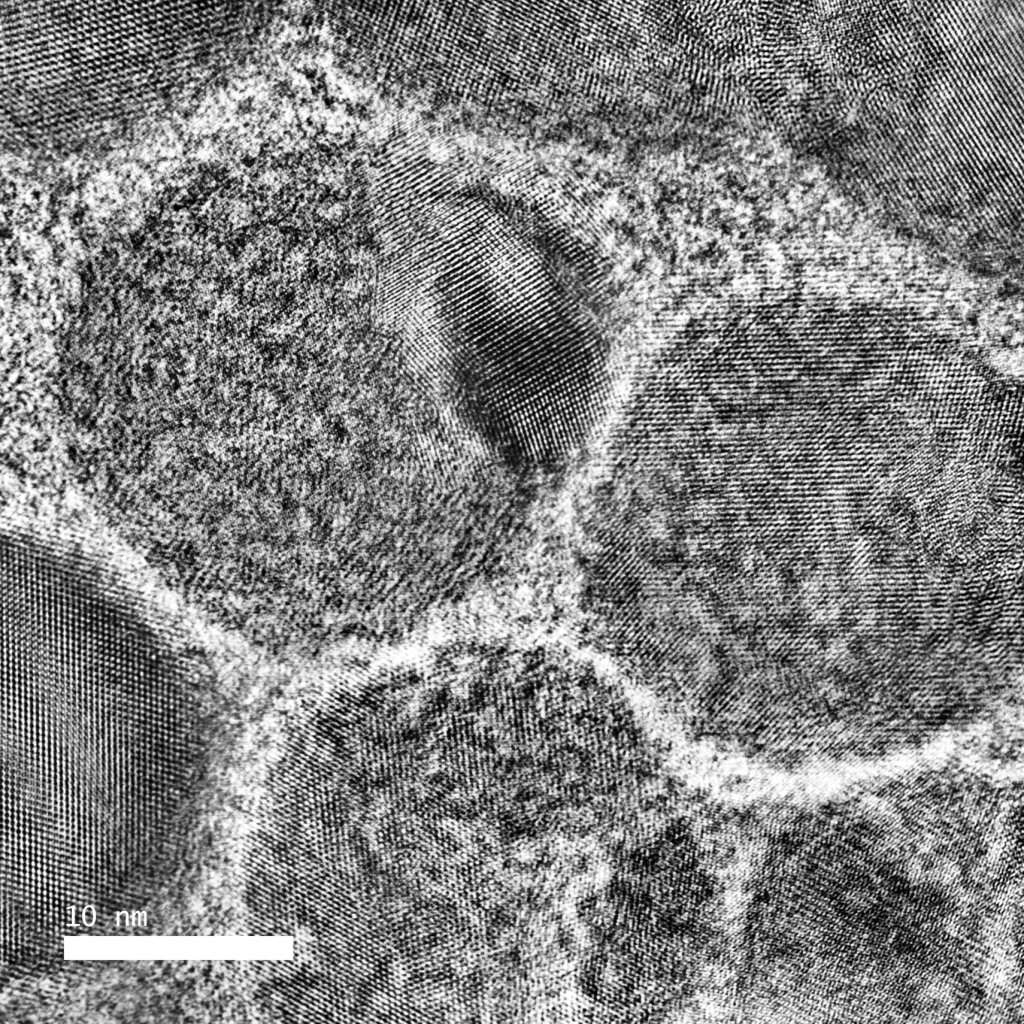
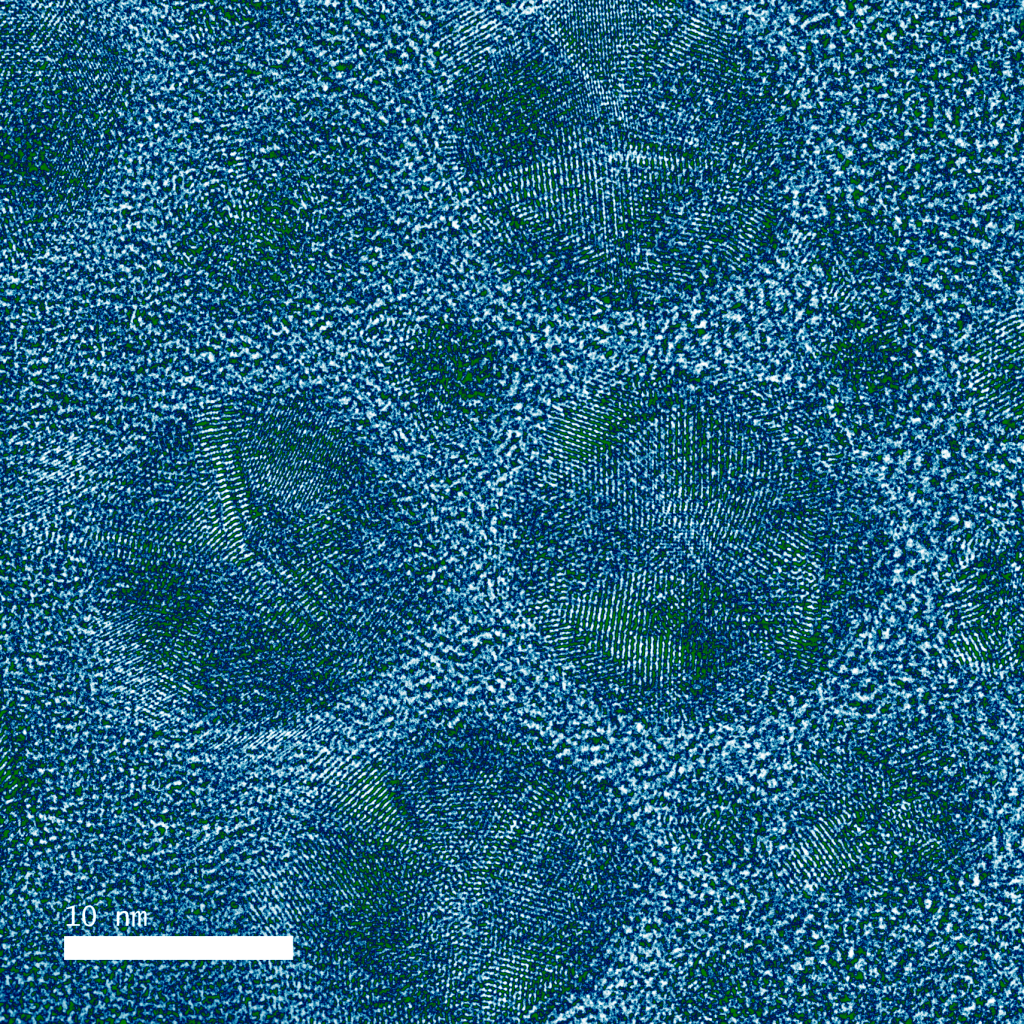
Defects and lattice distortion can create or suppress ion-transport pathways in metastable nanocrystals. We use electron microscopy, diffraction, and structural analysis to connect local strain, disorder, and phase topology with transport behavior in chalcogenide ion conductors.
Figure 3: Strain and defect mapping provide microscopic evidence for transport-relevant disorder in metastable chalcogenides.
Selected Works:
- Under Review: Contrasting Strain Topologies in Ag₄Zr₃S₈ and AgZrSe₂ Nanocrystals
- Under Review: Refinement-Free Structural Descriptors for Interpretable Machine Learning of Ionic Conductivity
4. Processable and Data-Guided Ion-Transport Materials #Structure-property_phase_mapping, #Polymer–NC_Electrolytes, #Printable_Materials, #Data-Guided_Discovery
PBEnergyLab studies how nanocrystal surface chemistry, polymer matrices, processing history, and mesoscale connectivity influence ion transport in films and inks. In parallel, we build synthesis–structure–property maps that connect experimental variables with diffraction, microscopy, and electrochemical response.
Figure 4: Polymer–nanocrystal films and data-guided maps link processing, structure, and transport across complex materials libraries.
Selected Works:
- Under Review: Strain-Programmed Nanoionics in Printable Superionic Nanocrystal–Biopolymer Inks
- Under Review: Refinement-Free Structural Descriptors for Interpretable Machine Learning of Ionic Conductivity
- Invited: Interphases in Polymer–Nanocrystal Electrolytes